Share
De-Risking Therapeutic Polymeric Nanoparticle Programs with Phase-Appropriate Analytical Methods
Therapeutic polymeric nanoparticles are complex delivery systems, with multiple physicochemical properties influencing their performance in the body. As these formulations progress from early development toward clinical manufacturing, the analytical questions change—and so does the level of rigor required to answer them.
A stage-appropriate analytical strategy helps developers focus on the right attributes at the right time, building understanding while reducing development risk.
Benefits of PNPs
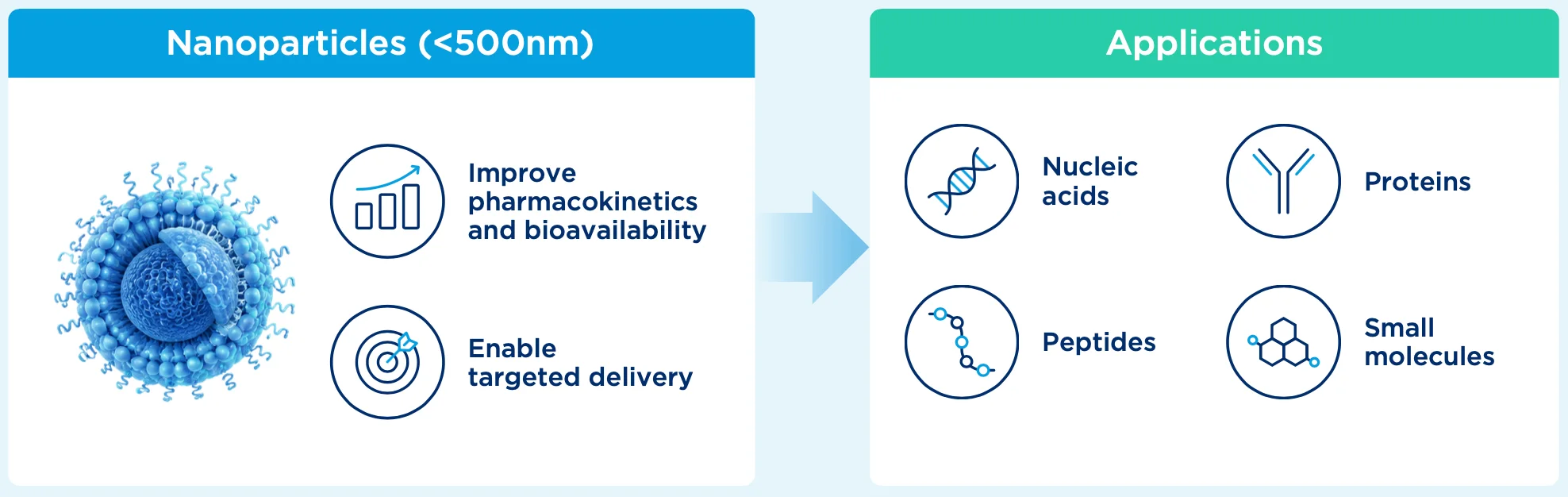
Polymeric nanoparticles (PNPs) can protect cargo, improve pharmacokinetics (PK) and bioavailability, enable targeted delivery, and enhance tissue penetration and intracellular delivery across a range of cargos, including small molecules, proteins, peptides, and nucleic acids.
Realizing these benefits requires a clear understanding of particle properties and performance throughout development. Analytical methods are therefore essential for characterizing these characteristics and guiding formulation and process development.
Therapeutic Nanoparticles At-a-Glance
Why Implement a Risk-Based Approach?
A risk-based approach to analytical method development ensures that, from the outset, physicochemical properties, stability, and biological performance are well understood. It progressively increases understanding of these properties as the program advances, while ensuring that analytical methods remain fit for purpose at each stage of development. Method qualification and validation can then expand as programs progress toward late-stage clinical development and commercialization, generating the data needed to support regulatory submissions and meet requirements at each stage.
Choosing Stage-Appropriate Methods
A stage-appropriate analytical approach can make drug development more cost- and time-effective while enabling more informed decision making. Early in development, analytical methods should generate enough information to compare formulations, identify critical attributes, and guide optimization without introducing unnecessary complexity. As a formulation advances, analytical methods can become more rigorous and comprehensive to support process understanding, reproducibility, and regulatory expectations.
The resulting data support informed, data-driven decisions throughout formulation and process development, while also generating the evidence needed to support an investigational new drug (IND) application and first-in-human proof-of-concept studies.
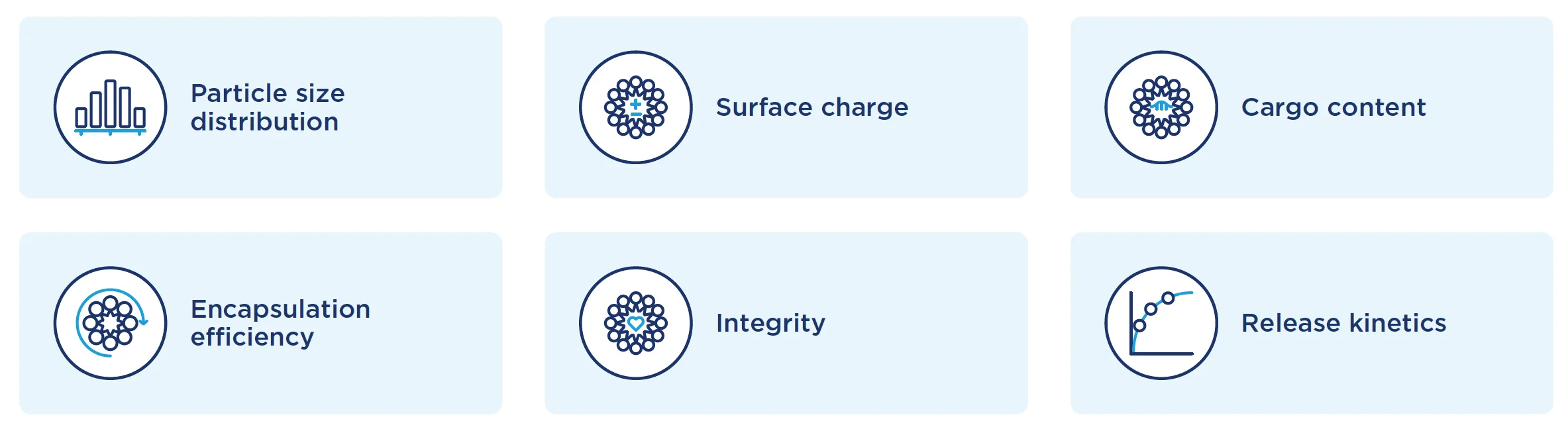
Important Attributes for Proof of Concept
Understanding Physicochemical Properties
Analytical methods generate essential data that drive decision-making during PNP development programs. Examples include physicochemical properties such as particle size, surface charge, and cargo stability. Particle size can influence biodistribution and cellular uptake and can also dictate the required sterilization strategy. Nanoparticles can typically be filtered through 0.2-micron sterilizing filters, while microspheres may require fully aseptic processing or terminal sterilization.
Surface charge and cargo stability are other important properties to understand well during development. For more information about other key attributes, read our article, Derisk Therapeutic Nanoparticle Programs with Stage-Appropriate Analytical Method Development.
Advancing to Lead Formulation
As programs advance toward lead formulation selection, understanding the PK and biodistribution of therapeutic nanoparticles becomes increasingly important. At this stage, analytical methods can measure parameters such as circulation half-life, cellular uptake, and organ accumulation
Evaluating PK and biodistribution in relevant in vivo models as early as possible is critical, while strategies that improve translatability can help increase the proportion of successful formulations. Early characterization can also inform formulation optimization and streamline manufacturing decisions. Scaling up production from lab-scale equipment to clinically relevant unit operations can alter API distributions and morphologies.
Solvent evaporation techniques, evaporation rate, and residual solvent content are critical attributes for sustained-release applications that can affect API distribution, particle morphology, and release kinetics. Syringability and injectability are additional parameters that can inform key considerations such as drug loading, injection volume, and needle gauge selection. Injectability and syringability can be studied costeffectively using an Instron device before proceeding to in vivo studies.
As Programs Move Toward GMP
As programs advance toward clinical development and beyond, robust analytical methods that support qualification and validation are required. At this stage, the analytical strategy must demonstrate not only that the formulation performs as intended, but also that it can be consistently characterized and controlled as manufacturing processes evolve. These data help inform safety and tolerability assessments and support the critical translation of animal data to human studies.
Putting Strategy into Practice with Phosphorex
Phosphorex has focused exclusively on particulate-based drug delivery systems since its founding, with more than two decades of experience applying the analytical methods required for particulate-based systems. We can help you implement phase-appropriate analytics that assess the right attributes at the right time for streamlined development programs.
Achieve better delivery with less risk. Contact us to discuss your next project.