Share
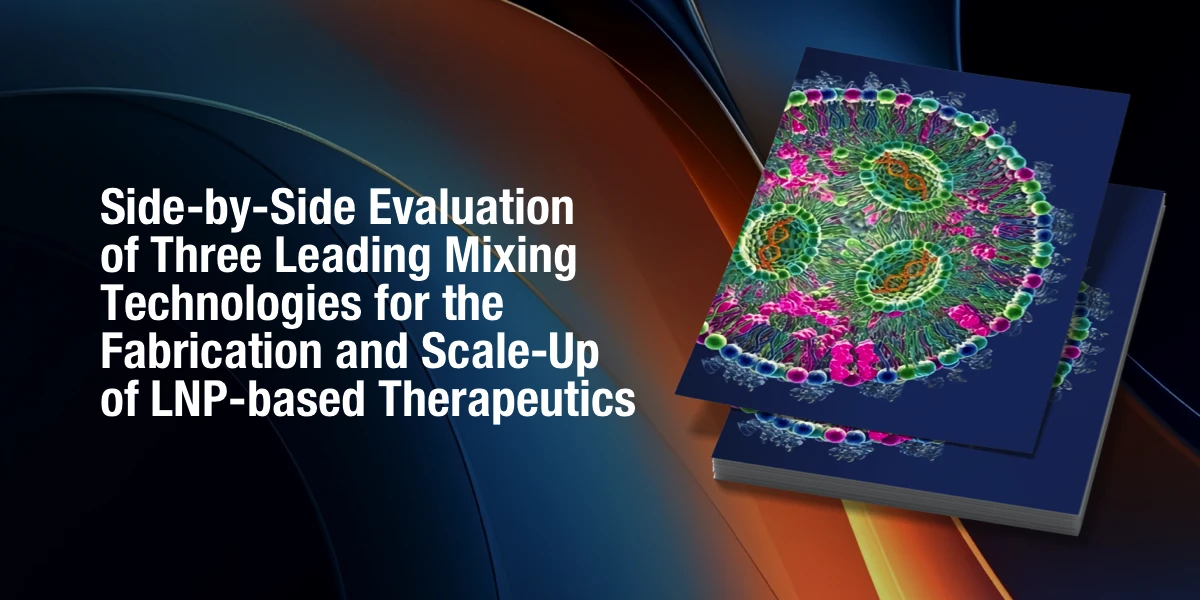
Side-by-Side Evaluation of Three Leading Mixing Technologies for the Fabrication and Scale-Up of LNP-based Therapeutics
Introduction
Lipid nanoparticles (LNPs) are the leading non-viral delivery system and offer many potential advantages over viral delivery systems including capacity for larger payloads and option for repeat dosing. LNPs can be utilized to deliver a wide variety of payloads (e.g., siRNA, mRNA, and pDNA) and are being tested clinically to treat a broad range of indications including infectious diseases, cancer, and rare diseases.
LNPs form through a self-assembly process in which lipids prepared in ethanol undergo rapid mixing with mRNA prepared in an aqueous buffer. Various mixing technologies are commercially available to support LNP manufacturing across a range of process scales. One of the challenges during LNP formulation scale-up is the ability to maintain the LNP critical quality attributes including size, polydispersity (PDI), and encapsulation efficiency (EE%). In addition, selection of the preferred mixing technology remains challenging partly due to a lack of available side-by-side data comparing the fabrication of LNPs across these mixing platforms.
Therefore, the goal of this study was to compare the fabrication and scale-up of a model LNP formulation across three mixing platforms including Unchained Labs’ Sunshine System, Precision NanoSystems’ Ignite+ and Blaze systems, and Phosphorex’s in-house T-mixer system.
Want to Learn More?